
Several brokerage houses have given a year-end target of as high as 30,000 for the BSE bourse's benchmark Sensex, with fund managers telling investors not to redeem though the index is still only around 25,000.

Ironically, bad loans and non-performing assets are on the rise in public sector banks in India, say sector watchers.

Sensex ends in green on boost from bluechip stocks.

In all likelihood, the next conventional Chinese attack on India would be preceded by a massive cyber attack designed to cripple Indian networks and interfere with our disaster-relief programmes.

'These companies hired in high numbers last year and are balancing that out this year by recruiting fewer freshers.'

'Every actor's journey is unique.' 'It's beautiful but also terrifying because you have to carve your own path.' 'So if there's somebody to talk it through, it's nice.'

Meesho has emerged as the second-largest player by order share in this year's festive sales till now, surpassing Amazon, while Flipkart Group platforms topped the market in both orders and gross merchandise value (GMV), according to according to a report by consultancy firm Redseer. It said Flipkart Group maintained its leadership position with a 62 per cent market share in terms of GMV during the first week of the festive season, followed by Amazon which had 26 per cent share, while the remaining 12 per cent was distributed among other e-commerce players. In terms of order volume, Flipkart Group again leads the market with about 49 per cent share and SoftBank-backed Meesho ranks second with about 21 per cent order share, according to Redseer.

'...Market-linked debentures, high-value insurance, exemptions from capital gains by investment in real estate, etc.' 'So, there are a number of measures directed at collecting a fair share from higher income individuals.'

Indian companies are expected to dole out an average increment of 9.1 per cent in 2022, higher than the pre-COVID-19 increment in 2019, as companies are focusing on retention of talent through rewards. According to the 2022 Workforce and Increments Trends Survey by Deloitte Touche Tohmatsu India LLP, the average India 2022 increment is expected to go up to 9.1 per cent from eight per cent in 2021. Moreover, the 2022 projected increment is higher than the pre-COVID-19 increment in 2019 by 50 basis points (bps).

Advice to the new finance minister from former RBI governor Raghuram Rajan: 1. Clean up banks by reviving projects that can be revived after restructuring debt. 2. Improve governance and management at public sector banks. 3. De-risk banking by encouraging risk transfers to non-banks and the market. 4. Reduce the number and weight of government mandates for public sector banks, and for banks more generally.

Even if the Paytm fiasco does not mark the end of the bull run, at least some sanity will return to the wild IPO market, observes Debashis Basu.

Here's a look at how key Tata group companies fared under Cyrus Mistry's stewardship.

India's economy is estimated to contract by 9.6 per cent in the fiscal year 2020-21, reflecting a sharp drop in household spending and private investment, and the growth is expected to recover to 5.4 per cent in 2021, the World Bank said on Tuesday. In its Global Economic Prospects report, the World Bank said that the informal sector, which accounts for four-fifths of employment, has been subject to severe income losses during the COVID-19 pandemic.

IMF Chief Economist Gita Gopinath also said the pickup in global growth for 2020 remains highly uncertain as it relies on improved growth outcomes for stressed economies like Argentina, Iran, and Turkey and for under-performing emerging and developing economies such as Brazil, India, and Mexico.

The broader markets are outperforming the benchmark indices.

The 30-share Sensex closed at 27,112 up by 481 points whereas the Nifty ended higher by 139 points at 8,115.

BS Annual Awards 2014: Power-packed jury picks the best 7 of corporate India

Once average inflation for India of 5.7 per cent is taken into account, the projected increase in real terms for 2017 will be 4.3 per cent

The first step to keeping your job safe, experts tell Rediff.com's Divya Nair, is understanding why layoffs happen.

With this subdued forecast, India is likely to record its worst growth performance since the 1991 liberalisation. However, it is among the only two major economies, which will register a positive growth rate in 2020. The other being China, for which the IMF has projected a growth rate of 1.2 per cent.
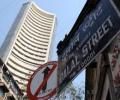
Markets are likely to go down, correct and stay subdued.

Shares of RIL ended 2.4% higher as it pips TCS to become most valued firm

All real estate developers may not be able to avail the benefit of Reserve Bank of India's one-time restructuring scheme as they might not meet the required financial ratios and have the necessary credit rating, HDFC vice chairman and CEO Keki Mistry said. He was speaking at a real estate and infrastructure investor summit organised by Naredco. "Restructuring may not necessarily help every developer because not too many will be able to meet the criteria laid down in terms of meeting the various ratios and getting credit ratings," Mistry said.

The Budget oration of the finance minister and the confidence with which she delivered it, along with the measures and the recent upsurge in the economy would all contribute to unleashing the storied 'animal spirits' and help the economy run on the growth path quite smoothly. Or so the government hopes, notes Shreekant Sambrani.

Business failures rise when growth declines. When Indian growth slowed in the last decade, defaults increased. This is the normal working of the market economy, points out Ajay Shah.

For development finance institution to succeed now, the government must stand like a rock behind it and be patient.

The 30-share Sensex and the 50-share Nifty ended flat at the mark of 29,008 and 8,767 respectively.

In yet another move to close the regulatory gap between banks and shadow banks, the Reserve Bank of India (RBI) has mandated exposure limits to the non-banking finance companies, in line with commercial banks. In the large exposure framework released on Tuesday, the regulator capped aggregrate exposure of NBFCs which are in the upper layer toward one entity at 20 per cent of capital base. The limit can only be extended by another 5% with board's approval. For a particular borrower group, the cap is at 25 per cent, with additional 10 per cent if exposure is towards infrastructure.

India's public debt ratio, which remarkably remained stable at around 70 per cent of the GDP since 1991, is projected to jump by 17 percentage points to nearly 90 per cent because of increase in public spending due to COVID-19, the IMF said.

Jubilee's irresistible celebration of cinema and all its good, bad, ugly ways lives up to its title, applauds Sukanya Verma.

Though global IT services spending is likely to cross the $1-trillion mark to reach $1.031 trillion, growth rate will slow to 3.8% in 2019, compared to 6.7% last year according to reports

Brokers like Vasudevan are struggling to keep themselves in tune with this super-informed, new-generation retail investor.

In mid-2020, when Kushal Pal Singh, the undisputed king of India's vast real estate market, relinquished the top post at the country's largest realtor, he left behind an empire that is best compared to the Greek myth of the Phoenix. Once the leader of Delhi's organised real estate market, DLF's steep decline in the 1970s and its majestic rise since has often been cited as a business resurrection story. Now, a year after his departure from the helm of affairs, history seems to be repeating itself at the real estate major. In the 1970s, it was the government prohibitions that had forced DLF to venture into uncharted territory; some five decades later, the Delhi-headquartered firm has set its eyes on another growth trajectory that holds immense potential.

Armed with necessary macro and micro growth drivers, India is on its way to becoming the fastest growing major economy in the world, a finance ministry report said. Rapid vaccination and teeming festivities will push India's ongoing recovery resulting in narrowing of demand-supply mismatches and greater employment opportunities, as per the monthly Economic Review prepared by the ministry.

Record liquidity infusion by the central bank in the banking system during the financial year 2020-21 amid sluggish economic activity resulted in banks investing more in safe government papers than in extending loans, data from Reserve Bank of India (RBI) showed. This trend has not been seen in nearly two decades, barring 2016 - the year of demonetisation.

Fitch Ratings on Monday said it expects a moderately worse sector outlook for Indian banks for the next fiscal beginning April 1 based on muted expectations for new business and revenue generation, and deteriorating asset quality. Fitch believes that the disproportionate shock to India's informal economy and small businesses, coupled with high unemployment and declining private consumption, have yet to fully manifest on bank balance sheets. The rating agency said the impact of the COVID-19 pandemic is likely to pose challenges to Indian banks' improving financial performance once asset-quality risks manifest in the financial year ending March 2022.

Despite a healthy March-May quarter (Q3FY22) show by global IT consulting firm Accenture, Indian IT companies shed up to 3 per cent on the National Stock Exchange (NSE) on Friday as analysts continued to highlight medium-term pain points for the sector. The Nifty IT index settled 0.9 per cent lower on Friday, as against a 0.9 per cent rise in the Nifty50 index. According to analysts at ICICI Securities, Accenture's Q3 saw moderation in year-on-year growth rate across verticals and US regions, which signals at likely normalisation in revenue momentum for Indian IT services going forward.

Finance Minister Nirmala Sitharaman's Rs 30,600 crore government guarantee for the bad bank has changed the body language of bankers for the better, observes Tamal Bandyopadhyay.

'We still need a certain number of large public sector banks for financial inclusion and stability purposes.'

The public-private partnership model is a compulsion, says the minister.
